

Mass2040
One of the biggest issues in 2026 is the cost of housing. But homes did not get expensive overnight.
After the 2008 financial crisis, housing construction slowed sharply, and years of decisions that limited new supply gradually accumulated. What now feels like an immediate crisis is, in part, the result of choices made more than a decade ago.
So which decisions being made today will the next generation look back on as costly mistakes?
To explore that question, governments, international organizations, and businesses often use a method called scenario planning. Scenario planning does not attempt to produce a single prediction. Instead, it develops several plausible futures and asks what combination of events could lead to each one. The goal is to challenge assumptions, identify threats and opportunities, and consider what decisions today could either reduce future risks or make better outcomes more likely.
To my knowledge, no campaign for state legislature in America has undertaken a public scenario planning project of this kind. Yet it is difficult to govern responsibly without considering where the Commonwealth may be heading, what forces could disrupt its current path, and what kind of future we want public policy to help create.
Mass2040 therefore examines four possible futures for Massachusetts in the year 2040. The children entering pre-k this September (like my son) will graduate from high school that year. Decisions made during the next several legislative sessions will help determine the economy, public services, infrastructure, and cost of living they inherit.
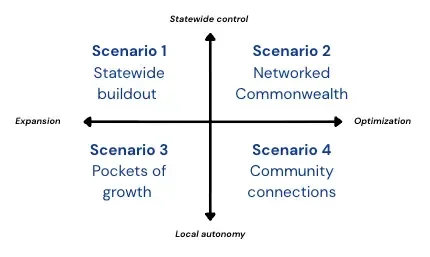
The scenarios are built around two critical uncertainties.
The first is statewide control versus local autonomy. This would look at whether Massachusetts moves over the next 15 years to more state-level action or decentralizes more to allow cities and towns to maintain local control over issues.
The second is capacity expansion versus optimization. This includes housing production, transportation, energy systems, water and climate resilience, and other elements of the built environment that support daily life and economic growth. Are we making more of them, or better using what we already have.
Combining high and low outcomes for these two variables produces four distinct worlds. The following pages describe how Massachusetts could arrive at each one and examine the implications for transportation, the cost of living, education, energy, and healthcare.
I wish to stress that these scenarios are not predictions. Maybe none of these worlds become true, or elements of a few different ones do.
They are tools for thinking more clearly about the choices before us.
Ask yourself what we could do to avert the downsides of each scenario and ensure we get the upside. Consider what legislation to be passed now might get us to a better place in 2040.
Ultimately, we get to choose what world we live in, and the work to do that starts now.
Scenario 1: The Statewide Buildout
State coordination + capacity expansion
By the late 2020s, Massachusetts’s affordability problem had become an economic competitiveness problem.
The turning point came when these constraints began to threaten investment. A series of major employers warned that expansion would occur elsewhere unless housing, energy, and transportation capacity improved. At the same time, federal industrial policy continued to support biotechnology, clean energy, advanced manufacturing, and research. Massachusetts had an opportunity to capture new investment. But only if it could build fast enough.
That produced a new political coalition. Employers wanted labor supply and infrastructure. Construction unions wanted a long pipeline of projects. Younger renters wanted housing. Environmental groups supported transmission and clean-energy expansion. State leaders increasingly argued that local veto points were preventing Massachusetts from meeting statewide needs.
The Legislature responded by shifting authority upward. Housing targets were mandatory for municipalities and infrastructure spending became tied to results. Regional rail and bus improvements made more places accessible to employment. Additional transmission reduced energy constraints.
But this new system generated considerable opposition. Towns that had accepted growth voluntarily saw less conflict than communities where targets were imposed. Transmission corridors, substations, and dense housing concentrated costs locally even when benefits were statewide. A few high-profile cost overruns strengthened a counter-movement arguing that Beacon Hill had become too powerful.
By 2040, Massachusetts had significantly more physical capacity than it did fifteen years earlier. Regional cities such as Worcester, Lowell, and New Bedford had grown, while Greater Boston had added substantial housing around transit and commercial corridors.
The Legislature’s problem was no longer whether Massachusetts could build. It was whether the coalition supporting construction could survive the distributional conflicts that construction created.
What this means for:
Housing: More growth in Gateway Cities and the 128 to 495 area, but persistent shortages in workers delay projects
Transit: Regional rail, underway by 2040, has helped connect Worcester, Lowell, and Brockton closer to the job centers in Downtown and Kendall
Energy: Prices remain steady as increased supply is matched by increased demand
Education: More housing for young families helps some communities avoid the declines in student population that is affecting most of New England
Scenario 2: The Networked Commonwealth
State coordination + system optimization
The Networked Commonwealth emerged from a decade in which Massachusetts repeatedly discovered that large-scale construction was more difficult than expected.
Federal fiscal pressure reduced infrastructure grants. Interest rates remained above pre-pandemic levels. Global conflict and trade disruption periodically increased the cost of transformers, building materials, and transit equipment. Several major projects ran late or over budget, weakening public confidence in ambitious capital programs.
At the same time, the state’s population grew slowly. Aging increased demand for healthcare and public spending without producing equivalent workforce growth. Technology provided an alternative. Artificial intelligence improved scheduling, logistics, and forecasting. Smart meters and batteries allowed electricity demand to shift across the day. Telehealth and remote monitoring stretched healthcare workforces. Transportation agencies became better at predicting demand and coordinating services.
A coalition formed around the idea that Massachusetts should first use existing capacity more intelligently. Fiscal moderates liked the lower capital costs. Environmental groups supported reduced resource use. State agencies favored coordination.
The Legislature introduced congestion pricing in Boston and encouraged hybrid work to ease pressure on the transit system. School districts increasingly shared specialized staff and facilities. Utilities adopted time-of-use pricing. Healthcare relied more on telemedicine, nurse practitioners, centralized referrals, and home monitoring.
Much of this system worked, but the downsides became clearer over time. Optimization created visible winners and losers. Someone able to work remotely could avoid congestion charges and peak travel periods. A nurse working a fixed shift could not.
The system also became increasingly intrusive. The Legislature therefore spent increasing amounts of time on privacy rules, algorithmic transparency, low-income protections, appeal rights, and minimum service guarantees.
What this means for:
Transit: No new lines are built or electrified during this period. The focus is on congestion pricing and dynamic tolling.
Energy: Homeowners are the big winners if they have the cash to install solar panels and batteries to take advantage of dynamic pricing.
Healthcare: Telemedicine becomes a common way for primary care visits to curtail costs, but debates emerge about whether to save even more money by allowing for AI evaluations.
Housing: Areas further away from Boston see growth as the remote working allows more of the labor market to physically spread out.
Scenario 3: Pockets of growth
Local autonomy + capacity expansion
By the early 2030s, Massachusetts still wanted more housing, energy, and economic growth, but statewide coalitions had become difficult to sustain. At the same time, federal policy increasingly relied on tax credits, competitive grants, and public-private investment rather than large programs administered through state government.
That favored places with land, institutions, and strong local coalitions. Universities and hospitals became increasingly important anchors. Hybrid work made it easier for households and employers to locate outside Boston. Modular construction, local energy systems, and new transportation technologies lowered the minimum scale required for development.
Rather than trying to impose a single statewide strategy, Massachusetts gradually loosened home-rule restrictions and gave municipalities more authority over economic policy.
The important development was not simply that some cities and towns chose different paths. It was that the divergence became self-reinforcing.
Communities that succeeded attracted employers and residents. Their tax bases expanded. Better tax bases financed better schools, planning departments, parks, and infrastructure. Those advantages made them even more competitive for the next round of federal or private investment that were crucial for continued growth.
The opposite happened elsewhere. They became less capable of writing successful grant applications or managing complicated projects.
By 2040, Massachusetts had several distinct regional economies rather than one dominant Boston-centered model.
Young adults willing to move gained more options. Entrepreneurial municipal governments and universities gained influence. Businesses could choose among communities pursuing different development strategies, but that also meant that cities and towns became strained because local taxes could be easily evaded by moving a town over.
Beacon Hill increasingly functioned as referee rather than planner. Its most important responsibilities were setting minimum standards, making regional cooperation easier, and preventing weak municipalities from being permanently left behind.
What this means for:
Housing: Local politics becomes divisive in many communities, as whether to be a town that builds or not is a dividing line in select board and council elections.
Higher education: Colleges and universities become economic hubs even more than they are now, and cities compete for new centers.
Transit: The MBTA is complemented by local shuttles, bike systems, and autonomous transit companies.
Education: Prop 2 ½ overrides become frequent across the state.
Scenario 4: Community connections
Local autonomy + system optimization
Economic growth weakened during the late 2020s and early 2030s. Federal spending was increasingly absorbed by debt service, defense, entitlement programs, and disaster recovery. Immigration slowed. Massachusetts aged, while younger workers increasingly moved toward regions with lower housing costs and faster-growing labor markets.
Artificial intelligence reduced employment in some professional and administrative sectors. Higher education faced smaller cohorts of traditional-age students and greater international competition. Public revenues grew slowly even as healthcare, pensions, climate adaptation, and maintenance costs increased.
Some communities no longer had enough students to sustain existing schools, enough riders to support traditional transit, or enough medical professionals to maintain local facilities. State government could not afford to replace every declining service with a larger statewide system.
The political coalition that emerged favored stability. Older homeowners wanted to age in place. Municipal leaders wanted flexibility. Nonprofits and civic organizations increasingly filled gaps left by state systems. Voters became more skeptical of large projects and more interested in preserving existing communities.
A school serving half the students for which it had been built became a combined school, childcare center, senior center, clinic, and library. Towns shared teachers, inspectors, emergency dispatch, and public-works equipment. Churches and municipal buildings became housing. Community land trusts acquired property. Local shuttles and demand-responsive vans replaced ambitions for major transit expansion.
In some areas, this produced a continued vibrancy. In others, economic stagnation meant that they were left behind. Geography increasingly determined whether localism felt like resilience or abandonment.
Beacon Hill therefore had to focus state aid on keeping minimum services available and encouraging regionalization where municipalities could no longer sustain them independently. However, this led to frequent clashes about whether the state was subsidizing places that could be run more efficiently with the taxes that came from the places that had already made hard choices.
What this means for:
Transit: Major expansions stop as it becomes harder to justify them politically.
Higher education: Universities see declining enrollment with there being fewer college-age students from the US and abroad, leading to economic challenges.
Energy: Municipal microgrids and rooftop solar become ways for cities and towns to create resiliance without having to wait for major infrastructure projects.
Government services: With revenues growing slowly, major new programs like universal childcare remain on the wishlist, not having been realized.
What this all means for Massachusetts
These scenarios are not necessarily going to come true. But they could.
Each one has been designed to be plausible and based on current trends or variables that we know may matter over the next 15 years.
We have also been minimal in talking about the implications for different sectors. Because that is for you to do.
If you are working around the Massachusetts political system - or if you just care about a particular issue - ask yourself what you think might happen to it in each scenario.
Are there any funding streams, political coalitions, or other assumptions that could be tested?
Once you’ve done that, ask what could be done to prevent that. Is there something that you could work to that would mitigate the downsides and maximize the upsides?
That gives you a roadmap for how we may respond to events in the coming years and what legislative approaches to take.
Scenarios like these should not be seen as a clear guide to the future, but can help stress-test your own approaches to make sure that there isn’t anything you’re missing.
And then we can all get to work building a Massachusetts that we can be proud of in 2040.
This scenario planning project was created by the Chris Oates for State Rep campaign as a way of fostering discussion of the future of the Commonwealth. I want to thank everyone who contributed to it, including Lucy Chivers, David Green, Elise Newman, Anna Howe, Kelsey Oates, and Jesse Cohen.
